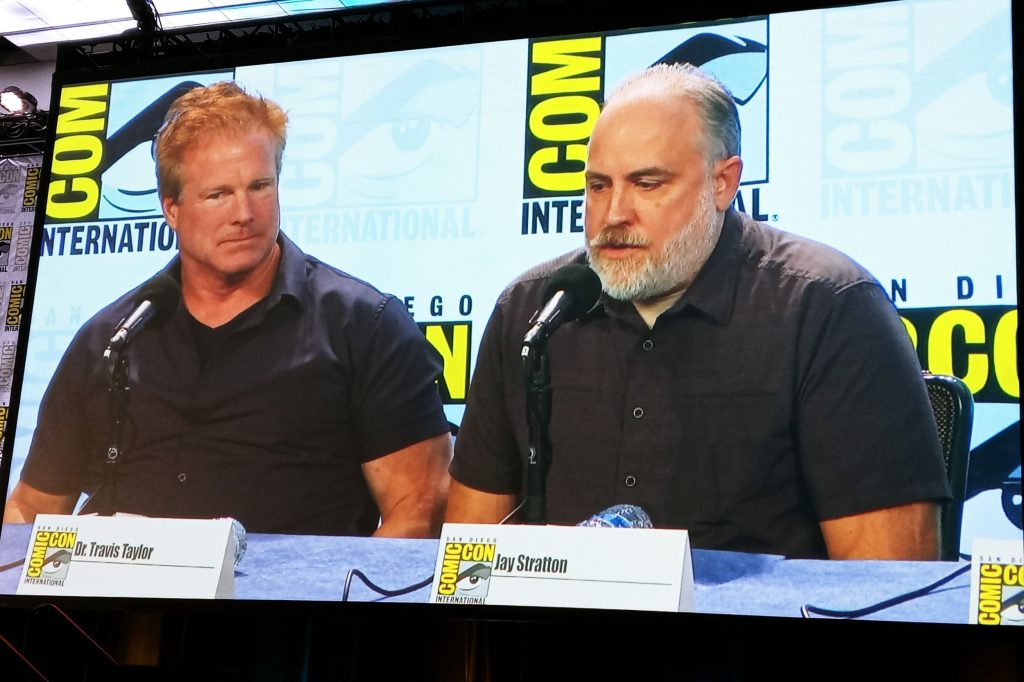
Dr. Travis Taylor and Jay Stratton at The Secret of Skinwalker Ranch panel at SDCC 2024. Photo: Sarabeth Pollock
With the season premiere of The Secret of Skinwalker Ranch season 7 fast approaching, it seemed like the right time to revisit my conversation with members of The Secret of Skinwalker Ranch cast at San Diego Comic-Con 2024 during the show’s first-ever panel at the convention. I’ve never been able to publish the full conversation in its entirety…until now.
At the time, the show was wrapping up its fifth season so the SDCC panel was looking ahead to season 6. I had a chance to speak with Astrophysicist and Aerospace Engineer Dr. Travis Taylor, Defense Intelligence Senior Executive (Retired) Jay Stratton and Skinwalker Ranch executive producer Joe Lessard after the panel and we had an amazing conversation about the show, the role of science fiction in innovation and how the show comes to life.
Sarabeth Pollock: I love that Skinwalker Ranch is a show at this great intersection between imagination and science. You want to imagine what’s out there, but then everything is based in reality and science. And now the show is at its first Comic-Con panel. You’re walking around these hallowed halls celebrating science fiction, full of people who grew up hoping that aliens are out there. So what is it like experiencing your first Comic-Con?
Joe Lessard: This is probably the question you were born to answer.
Dr. Travis Taylor: So it’s not my first Comic-Con. I’ve been to Comic-Con before, actually. I’m also a science fiction writer, and in 2011 I was here because my publisher had an autograph booth down on the floor and I was here for the whole week and experienced a lot of things. I mostly took my daughter, who was 10 at the time, to all the Disney things. But I did get to see The Walking Dead and Stargate Atlantis, and things like that.
I grew up watching Star Trek, Battlestar Galactica, Land of the Lost, all the shows that came on Saturdays like Voyage to the Bottom of the Sea, Lost in Space, all that stuff. And reading science fiction. I’ve been reading science fiction since I was old enough to walk. I was also reading comic books. I was big into Marvel Comics; I did read others, but Marvel was my favorite.
And that led me to thinking in terms of, so what if we really did have a big invasion or some other hidden invasion or whatever, as is the theme to many comics and science fiction stories. That led me to writing, and doing a detailed scientific analysis and writing a book on how we would defend the planet if it actually did happen. A serious study. And it kind of led me to Jay and to doing this show and to all of this. It came from that sort of search.
If you think about it, if you were going to put a team together, and I’ve told these guys this before, if we’re going to put a team together to figure out if we saw there was an alien invasion, or a potential threat for it. We don’t have people trained to understand what it is because it could be so weird.
I use, as an example, the Rocky Horror Picture Show. I’ve watched that show a thousand times and I still have no idea why the aliens were here other than to make a blonde man with a tan and to have parties and stuff. So I think [SDCC] is an ideal place to talk to folks and say, look, you guys are inspiring us. When I see Tony Stark invent a new doohickey that detects a gamma ray device from an ancient space artifact from super aliens, well, I think maybe that’s an idea we should think about because what would these super aliens have?
And so I think you can see that in [Skinwalker Ranch]. In fact, Netflix actually has the show ranked as a science fiction show. I mean, that’s how they classified it, and none of it’s fiction. Everything on that show is a hundred percent real. We’re not making any of it up. But it sure does seem like science fiction, doesn’t it?
Sarabeth Pollock: It really does. In the panel, it really struck me when you talked about how the funding for your investigations is based in entertainment and not any kind of governmental agency. It’s so striking, almost in a terrifying way.
Dr. Travis Taylor: It’s terrifying, absolutely.
Sarabeth Pollock: It’s almost like the movie Armageddon, where the government has to turn to the oil workers because they’re the only ones who can figure out this problem. Nobody else thought we should know how to do this.
Dr. Travis Taylor: That’s a perfect example. I was part of the community at the time, in the late nineties, where there were lots of us writing papers and going to NASA and going to the Air Force and various other government agencies to say, hey, we’re not preparing for a common impact or an asteroid impact. We don’t know anything about it. And it triggered some of the congressional interest in funding and doing missions to study comets and asteroids so we could know more about them.
But still today, we could not stop that from happening. We can’t even defend ourselves from a dumb rock. Now imagine if Thanos shows up, we don’t have the Avengers to protect us. We have nobody. And so I see that as if we can’t get it done the way our governments work, somebody’s going to have to do it somehow, however they can do it.
And if it’s through entertainment, I think it’s actually working better because it’s involving the general public and if you don’t involve the general public then you’re not going to have the interest behind it. One of the examples I use is the Apollo program when it was losing interest in Congress because Vietnam was going on and they didn’t want to spend more money just to go to the moon. And so Wernher Von Braun go in an airplane and left Huntsville, Alabama, and flew down to Florida and met with Walt Disney, and Walt Disney started putting these little space videos in front of all the Disney movies that everyone was going to and got the kids interested, who then got the parents who were voting age interested, and then that got Congress interested. So they continued pushing forward. That’s kind of what we have to do. The general public has got to be interested because the general public drives what happens in this country anyway.
Jay Stratton: And I had an epiphany. I mean, I realized that in leaving the government, my hands aren’t tied anymore. Because with the government, the things that we could do at Skinwalker Ranch 15 or 16 years ago, I was very limited in what I could do out there because of the rules I had to live by. And when I left the government and we’re sitting in the private sector, I’m like, I can go to a commercial company and cast signals for intelligence collection over the ranch if I want to because I’m not US Government anymore. So all those kinds of cool things started to open up.
But back to your original concern, the fact that the US Government kind of treats this as fringe and they don’t want to make the investments that are necessary so we have to rely on the entertainment industry. I can promise you that our key strategic adversary, China, is not in the same mindset.
Dr. Travis Taylor: They have a campus as big as the Manhattan project, and we know this for a fact and that’s about all we can say about it. We know that they take it seriously and the Russians take it very seriously. But we, for whatever reason, and I’m convinced it’s money laundering, but we for whatever reason are not taking it seriously at all. And that’s why shows like Ancient Aliens, Skinwalker Ranch, The Unexplained [with William Shatner] are key to the general public getting to see at least where some people are taking it seriously and showing them everything that they can find out about it. We’re not keeping anything from the general public. It just takes us a while. It takes us nine months to a year to get it and put it into a show and then put it on TV.
Joe Lessard: And it’s great for us to do as the producers, to do the public service of putting it out there and then getting to come and enjoy this kind of attention. It’s pretty neat.
Dr. Travis Taylor: And it’s a hell of a fun job. Adventurous.
Sarabeth Pollock: Joe, I was going to ask about something you mentioned in the panel about how things run in a linear fashion. Do you have to do a lot of editing, or are we seeing things play out in real time but in a condensed way?
Joe Lessard: Well, we’re very, very constrained by the amount of time that we can actually be in production. That is just an unfortunate reality of the whole thing, coupled with the fact that we’ve got to cover these guys doing what they’re doing when the weather is good enough. But we try to keep it linear because we want to follow their experiments that they design. We want to follow the experiment as it’s executed. And then there’s only so much time as they move on and do follow-up experiments to really crush the data from the experiment. So yeah, there’s a lot of editing. There’s a lot of things that these guys might find really, really interesting on a minute or esoteric level for the average brain.
Dr. Travis Taylor: That never makes it on the show no matter how much we complain about it.
Joe Lessard: We do have to pick and choose in terms of what gets presented to the audience and what the network also sees as valid and good material. And it’s all good, but what is the stuff that we can pack into 43 minutes this week that continues the story from last week and follows an evolution as best we can to tell their story as they figure things out?
Dr. Travis Taylor: And to be able to explain it in that amount of time. One story arc that we’ve done since the very first season every year is so complicated we can’t figure out how to tell the story. We got it, and it fits into it. I’m thinking about the remote viewing stuff. It’s fascinating but it’s just so complex and so much, it’d almost be a show in its own right.
And think of it this way: Every day there’s three main cameras running. There’s another four or five lock off cameras that are running. There are GoPros on everything. Then we’ve got about 20 security cameras looking in every direction. Then we’ve got all of our sensor cameras going, and all this is running all day long. And that’s thousands of hours of video for 42 minutes. So you’ve got to go through all that and figure out how you’re going to fit that in 42 minutes.
Sarabeth Pollock: I can barely keep track of my security cameras for 24 hours.
Dr. Travis Taylor: There you go. So think about when we find UFOs in the videos. A lot of times it’s after the fact because we were too busy focusing on what we’re doing, and somebody has to be watching through those hours and hours and hours to find it. So it’s a tough job.
Sarabeth Pollock: When I was listening to you talk about the hitchhiker incidents, it reminded me in a way of Ed and Lorraine Warren, the subjects of the Conjuring movies, where things would happen to them during their paranormal investigations. I had chills thinking that this isn’t just entertainment. It’s where the segue between or the intersection of entertainment and science kind of deviates, because while it’s entertaining and it’s a show, there’s a lot of reality to it that I think a lot of people don’t consider. And you do a really good job portraying that. It’s more than just something to watch because it’s real.
Dr. Travis Taylor: I used to not think much about those types of things. And I don’t like the word ‘paranormal’ because it suggests something that’s outside of whatever’s in the universe. If it’s in the universe, it’s there. So it’s normal. It’s just unusual. It’s something we don’t usually see. And I know that’s what they mean by saying paranormal, but after being at the Ranch, and after studying in detail how every individual’s perception of reality is based on your quantum interaction with the quantum universe, you’re going to render your own reality.
Think about playing a video game like Minecraft or Fortnite or any of these where you’re the person going around shooting and you don’t see the entire world map of the game at once. You only see the part of the world map you’re in, which is exactly what you’re doing. You’re rendering right now that view behind me and the wall, and I’m rendering another part.
And everybody’s view of the universe is different, and how they render it is going to be different. So I realize that what these people are seeing might be ghosts or demons or monsters or whatever. There might be some piece of the same phenomena that we are just now understanding because our sensors, our brain, our eyes, our nose, our touch, our smell, that’s about this much of all the spectra that you could measure. And when we build instruments now that are outside of what our bodies can detect, we see things in the infrared that we can’t see with the naked eye. In fact, Thomas and I one night chased something across the field because we could see it in the infrared and the night vision, but we couldn’t see it with our naked eye. So what was that? Was it a poltergeist? Was it some paranormal thing? I don’t know, but that is how you have to think about these things now. The universe is much different, much larger than we have actually been taught to understand.
Sarabeth Pollock: This is something that my best friend and I talk about frequently. He’s always asking why the things you discover aren’t on the news. Why isn’t it being covered? Growing up, I cut my teeth on The Twilight Zone and Coast to Coast radio, so I know Art Bell covered it and talked about it, but it wasn’t mainstream. But do you ever consider in the back of your mind what it would take to make that leap, that you see something that would get that kind of mainstream traction?
Joe Lessard: I suppose it depends on what it is. I mean, it’s the repeatable stuff that Erik [Bard] and Travis try to follow up on, applying the scientific method, trying different things. Until something pops up that looks like it’s got some kind of physical form, or it follows the theoretical model of an Einstein bridge or a wormhole, for instance, which is something that has come up several times on Skinwalker Ranch, until they are able to hit it with some kind of device or physically run into it themselves—.
Dr. Travis Taylor: Or pick it up and bring it back and say here, look at this.
Joe Lessard: Or see the thing manifest as something that cannot be denied by any kind of perception, I don’t think they’ll know. I don’t think they’ll know what that line is.
Dr. Travis Taylor: The perfect example is what Jay was saying about how we present information to particular senators that is dead on scientific information. We accept the data coming from these devices to decide to drop bombs on human beings. But when we said it’s something outside of what they normally understand, they said well I don’t believe that. So how do you present what data is going to be presentable to a general public that’s been told this isn’t real, or don’t believe this? I mean, I would say in this country, I’d say at least half of the country, if you told them that angels and demons were real, for example, they would say well, people believe that it’s a spiritual thing and it’s not necessary to be real. But if an angel showed up right in front of them, they would still have a hard time believing it, right?
But one thing I point out to them, and Rabbi Ariel Bar Tzadok, who has been on Ancient Aliens and Skinwalker Ranch many times, has often pointed out, an angel or demon by definition is an extraterrestrial. So all of this is something extra or ultra terrestrial. And that’s what’s a shame. I blame Carl Sagan for it. This nonsense about extraordinary claims requires extraordinary evidence. That’s not the scientific method at all. Scientific method is you do your homework, you devise a hypothesis and then you devise an experiment to test the hypothesis. Then you report the results and you repeat the experiment. And if you, from the beginning, say you’re only going to accept the extraordinary evidence, well, who’s the person who gets to decide what the extraordinary evidence is? Apparently the senator, for example, thought that radar detection of a device wasn’t extraordinary enough for him to believe that there was a thing there. We still have people denying that the gimbal object was a real object.
Jay Stratton: And the tendency in the government, at least in those circles, is we need more data. And they’re completely discounting pilot testimony. But these pilots can drop a nuke and kill thousands of people in their own decision, the strategic decision of employing force against an adversary, or we put people in the electric chair based on eyewitness testimony that is just perception driven.
So we get to the UAP topic and it’s like eyewitness testimony is no longer good. We just want radar data and we just want the radar data without the testimony. So without the testimony, you don’t really understand what was going on when that radar data was captured.
It’s important in the other aspect of all of this, the short attention span. One of the guys on the UAP task force testified to Congress all of these things he learned while on the UAP task force, which were extraordinary. And the next day they’re running Rihanna or whatever the next pop culture thing is. The attention span is dead. We hear this analogy all the time: If the UFO landed on the White House lawn, everybody would be…well, the reality is, would they land on the White House lawn or in Beijing with the larger population? People really need to think about the strategic concerns the United States should have and what we’re doing and the things that we’re not doing that the people could theoretically drive the government to do.
Dr. Travis Taylor: And it points back to all of this. Jay and I decided that we couldn’t change the inside of the government. We had people tell us we couldn’t go talk to certain congressmen and we had to have permission to do this or that. We’re outside of that. Now we’re going to talk to whoever the hell we want to, and we can show the general public whatever we want to show them. And that’s what we’re doing with Skinwalker Ranch. We’re going as deep as we can to find the smoking gun that we can set in front of everybody and say, hey! Honestly, I’d say the stuff we’ve shown in the five seasons is enough to show people there’s a real thing here that people don’t understand. But for whatever reason, there’s almost like a religion of debunkers. Their lives won’t function if they can’t debunk this to make people realize that it can’t be real. I don’t care what they say. We’ve got scientific evidence that says there’s something real there. I don’t know what it is, but there’s absolutely something real there.
Sarabeth Pollock: Last question here, and you kind of hit on this earlier. In five seasons the world has changed so much. Do you think there’s a shift in thinking among the general public now who see the show as doing a public service, and that maybe the show wouldn’t have worked 10 or 15 years ago without the new mindset?
Dr. Travis Taylor: 15 years ago is the right number for sure, because that’s when Ancient Aliens started, which is part of the culture shift. Erich von Däniken didn’t reach enough people through books, but Kevin Burns sure has reached a lot of people. Prometheus and History Channel and A&E Networks have reached a lot of people with Ancient Aliens and the other shows that are in the same genre like Oak Island, The Unexplained, The Tesla Files and now Skinwalker Ranch. It is a cultural shift that’s taking place. Art Bell was instrumental in that. There’s a much larger population of people who are at least looking and going ‘now, wait a minute.’ And now we are getting with the congressional testimonies more people who haven’t paid attention, who didn’t listen to Art Bell, who didn’t see those things, not the true believers or the Comic-Con goers. They’re seeing it maybe for the first time. And realizing that really, this was real, not stuff that was made up in Will Smith movies.
Jay Stratton: We were doing a presentation when we had some of the staffers and Travis was going through the analysis of the Gimbal. One of the guys there is from the Los Alamos labs, a scientist, and he’s watching all this going ‘I thought there was nothing to this. I thought it was just lens flare or whatever.’
Dr. Travis Taylor: So even scientists just took the debunkers word for it and went on. Yeah, there’s nothing there. That’s just people who talk about UFOs or little green men or whatever.
But the thing that I can’t emphasize enough about The Secret of Skinwalker Ranch is that this isn’t a TV show. It’s a documentary of a scientific investigation, which is shown on TV, but it is documenting the scientific investigation. We’re showing what’s happening and what the results are to the general public as soon as we can. And I can do nothing but praise everyone who’s been involved with it, from the network side to the production side to the people on the team doing the hard work every day. This is a dream job. It’s what I have wanted to do since I was a kid, since I was in third grade. I’m excited about it, and everyone at Comic-Con should be excited about it, too!
The Secret of Skinwalker Ranch season 7 premieres Tuesday, May 19, on The History Channel.
Discover more from My Nights Are Booked
Subscribe to get the latest posts sent to your email.




This really is an excellent article. I wasn’t expecting Travis and Jay to reveal so much and give this much time. You had the perfect questions for them as well. Makes me wonder if you are, at least partly, of alien origin –> outer space I mean. Nice job 🙂
A secret admirer
Definitely of Alien origin
AM